
Choosing the right Custom Fruit Juice Blends supplier requires more than comparing prices. Buyers need dependable sourcing, precise formulation, and consistent flavor from the first bottle to the last. A mango blend may look simple, yet its texture, acidity, sweetness, and color can shift during processing. Small differences become obvious on a supermarket shelf.
Dr. Kantha Shelke, a respected food scientist, has observed, “Food innovation must connect science with consumer needs.” This principle matters when evaluating a private-label juice partner. A capable supplier should understand fruit varieties, blending ratios, pasteurization, packaging, and shelf-life testing. They should also explain their process clearly. Vague answers deserve careful attention.
The top supplier is not always the largest factory. Sometimes, a smaller producer offers better communication and more flexible minimum orders. That can help emerging beverage brands test a guava-citrus blend without excessive inventory. However, flexibility should not replace quality control. Reliable suppliers provide ingredient specifications, batch records, sensory evaluations, and traceability documents. These details show professional experience.
A practical assessment should include sample testing under real storage conditions. Taste the product chilled, after opening, and near its stated shelf life. Check whether the aroma fades or the pulp separates. Not every supplier will perform equally well. That is the uncomfortable part.
This guide examines how to identify the leading Custom Fruit Juice Blends supplier through product quality, manufacturing capability, customization options, food safety practices, and customer support. It also considers value beyond the quoted price. A supplier may promise innovation, but evidence remains more persuasive than polished language.
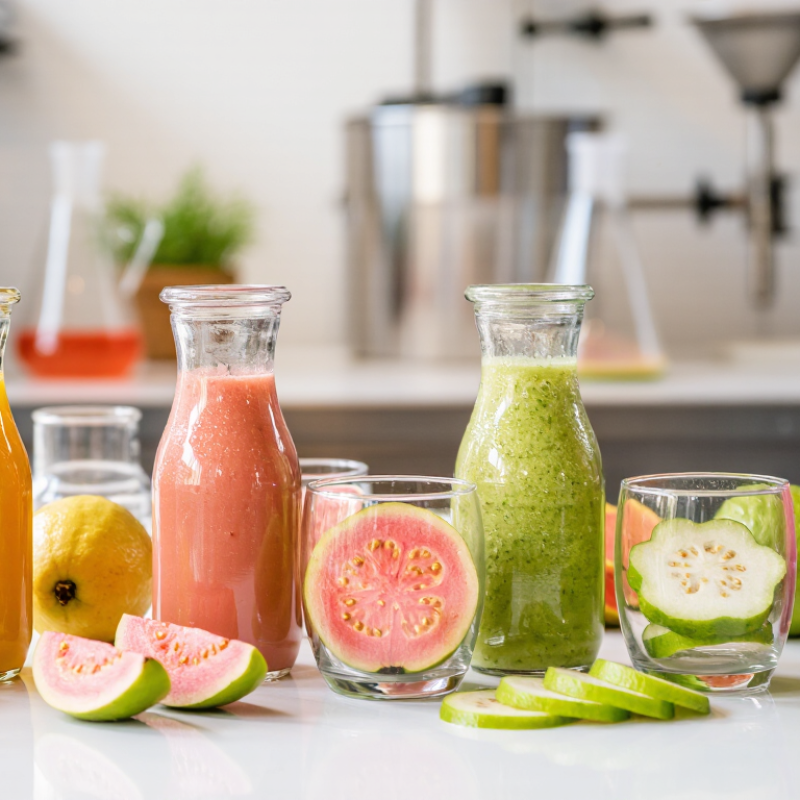
A strong China custom fruit juice blends supplier follows Codex Alimentarius, not only customer recipes. Codex Standard CXS 247-2005 defines requirements for fruit juices and nectars, including essential composition, quality, and permitted ingredients. This matters when a blend combines apple, berry, citrus, or tropical concentrates.
FAOSTAT data recorded more than 900 million tonnes of global fruit production in 2022. Large supply does not guarantee stable juice quality. An experienced supplier should verify fruit origin, soluble solids, acidity, color, microbiological safety, and pesticide controls. Batch records should connect each finished carton with its raw materials. A clear certificate of analysis helps, but it is not enough alone. On-site checks still matter. We often see attractive samples fail after storage. That weakness deserves honest review.
Tips: Ask for the Codex reference, ingredient specifications, allergen statement, shelf-life testing, and traceability procedure. Confirm whether the supplier can adjust Brix and acidity without hiding the original fruit character. Review pilot batches after heat treatment and transport simulation. Codex compliance is a useful foundation, not a complete quality guarantee. The best supplier combines technical formulation, documented hygiene controls, reliable testing, and practical communication. Price should come later.
China’s fruit sector gives custom juice blending a deep raw-material base. FAOSTAT production data places China’s annual fruit output above 300 million tonnes in recent reporting years. Apples, citrus, pears, grapes, and tropical fruits create different flavor and acidity profiles. Scale matters.
For a custom fruit juice blends supplier, this volume supports more flexible sourcing and seasonal formulation. An experienced factory can adjust pulp levels, sweetness, color, and acidity for different markets. FAOSTAT also shows strong concentration in major producing provinces, which can shorten supply routes for selected fruits. That advantage is practical, not theoretical.
Quality control remains the difficult part. The USDA Foreign Agricultural Service reports continued growth and modernization across China’s fruit processing sector. However, large production does not automatically guarantee consistent juice quality. A reliable supplier should verify orchard records, maturity standards, pesticide-residue testing, microbial controls, and batch traceability. It should also provide pilot samples before commercial production.
The data has limits. FAOSTAT measures agricultural output, not every processing loss or formulation result. That gap matters. A supplier may source plenty of fruit yet struggle with stable flavor between seasons. Buyers should compare laboratory specifications, sensory results, cold-chain procedures, and production records. The strongest partner combines China’s 300-million-tonne fruit base with disciplined blending experience.
Choosing the top China custom fruit juice blends supplier requires more than comparing prices or flavor catalogs. The stronger candidate can explain how each blend is developed, tested, and released. Ask whether its quality system addresses GB 7101-2022, HACCP, and ISO 22000 requirements. Ask for evidence.
A reliable supplier should provide current certificates, audit records, product specifications, and batch-level Certificates of Analysis. Their facility should show controlled water treatment, hygienic filling areas, calibrated instruments, and documented cleaning routines. Traceability should work from incoming fruit concentrate to finished cartons. A simple lot code should reveal production dates, ingredients, test results, and shipment details. Small details matter.
HACCP controls should identify hazards at practical points, including raw material reception, blending, pasteurization, and filling. ISO 22000 adds a structured food safety management system, communication controls, and continual improvement. GB 7101-2022 compliance should be checked against the exact product category and Chinese market requirements, not assumed from a general certificate. I would also request stability data for the intended packaging and storage conditions. One concern is often overlooked: a supplier may present excellent documents while handling customization slowly. Request pilot samples, revision records, and realistic lead times. No audit is flawless. Regular verification, complaint handling, and corrective actions reveal whether the system works beyond paper.
| Evaluation Dimension | What a Qualified Supplier Should Demonstrate | Evidence to Request | How to Verify | Assessment Status |
|---|---|---|---|---|
| GB 7101-2022 | Finished beverages intended for the Chinese market should meet the applicable requirements of China’s national food safety standard for beverages. | Current product specification, ingredient and additive information, finished-product test reports, and applicable Chinese label artwork. | Check that documents cover the exact beverage formula and product category. Confirm report issuer, sample identity, test date, and applicable standard with the issuing laboratory. | Not independently verified; confirm for each product and production site. |
| HACCP | A documented hazard analysis and critical control point system should identify relevant food-safety hazards and establish controls, monitoring, corrective actions, and verification. | HACCP plan, hazard analysis, process flow diagram, monitoring records, corrective-action records, and verification records. | Review records for the actual juice-blending process and site. If a HACCP certificate is presented, check its scope, validity, issuing body, and covered location. | Not independently verified; request current site-specific records or certificate. |
| ISO 22000 | An effective food safety management system should be implemented within the scope stated for the certified organization and site. | Valid ISO 22000 certificate, certification scope, site address, certificate number, and certification-body details. | Verify the certificate directly with the certification body or its public certificate register; confirm that the scope includes the relevant beverage manufacturing activity. | Not independently verified; certificate status and scope require confirmation. |
| Custom blend capability | The supplier should be able to develop a defined blend using agreed juice or puree ingredients, target characteristics, and processing requirements. | Product-development brief, ingredient specifications, trial samples, agreed formula version, and signed product specification. | Compare the approved sample and written specification with the final production batch documentation. | Assess through documented trials and specification approval. |
| Ingredient traceability | Ingredients and finished products should be traceable through supplier, lot, production, and dispatch records. | Ingredient lot records, supplier approval records, batch records, and a traceability or mock-recall report. | Ask the supplier to demonstrate a trace from a finished-product lot back to ingredient lots and forward to customer shipments. | Assess using a documented traceability exercise. |
| Batch consistency and testing | Routine checks should follow agreed product specifications and documented release procedures. | Batch certificates of analysis, release records, test methods, and relevant laboratory accreditation details. | Review representative recent batches and confirm that reported tests match the agreed specification and product risks. | Assess against agreed product-specific limits. |
| Packaging and export documentation | Packaging and shipping documents should match the product, destination, and customer requirements. | Packaging specifications, label proof, shelf-life support, packing list, and applicable export or shipment documents. | Check consistency across product name, ingredients, lot coding, storage conditions, and destination-market requirements. | Verify for each product format and destination. |
| Supplier selection outcome | A top-rated supplier is one whose product fit, food-safety controls, traceability, and documentation are independently verified for the specific order. | Completed supplier questionnaire, audit findings, corrective-action closure, verified certificates, and approved product documents. | Use a risk-based audit and document review; do not treat an unverified certificate claim as proof of compliance. | Rank only after evidence review; no supplier is rated here without verified records. |
Note: This table is a supplier-evaluation checklist, not a certification or compliance determination. Compliance depends on the specific product, facility, documentation, and current verification results.
Choosing a China custom fruit juice blends supplier requires more than comparing quoted prices. MOQ, production capacity, and lead time often reveal the real difference between factories.
For stock recipes with custom labels, many Chinese suppliers accept about 1,000 to 3,000 bottles per order. Custom formulas usually require 5,000 to 20,000 liters. Some factories negotiate lower MOQs for pilot runs, but the unit cost may rise sharply. Capacity also varies. A small plant may produce 50,000 bottles monthly, while a larger facility can exceed 500,000. Ask whether that capacity is dedicated to juice production or shared with other beverages.
Lead times deserve careful checking. Samples commonly take 7 to 14 days, including basic formula adjustments. Stock products may ship within 15 to 30 days after artwork approval. Custom blends often need 30 to 60 days, especially when fruit concentrates or packaging materials require separate sourcing. In my supplier reviews, delays usually came from label corrections, not blending. That detail is easy to miss. Request a written timeline covering sampling, ingredient confirmation, packaging procurement, production, and inspection. Also verify batch records, shelf-life testing, and export documentation before paying a deposit. A factory promising everything in ten days may sound efficient, but the promise can be unrealistic. Ask harder questions.
Who Is the Top China Custom Fruit Juice Blends Supplier?
The best supplier balances blend quality, cost, and export compliance. Price alone can mislead. A low quote may hide unstable fruit solids, weak traceability, or expensive port delays. During supplier audits, buyers should request three production samples from different batches. Compare color, aroma, viscosity, Brix, acidity, and sediment after storage.
Codex Standard CXS 247-2005 defines essential quality and labeling principles for fruit juices and nectars. A capable supplier should also provide batch records, allergen controls, microbiological results, and origin documents. ISO 22000 certification supports food safety management, but certification does not replace factory verification. WHO recommends keeping free sugars below 10% of daily energy intake. Therefore, suppliers should explain added sugar levels clearly and offer lower-sugar formulations. This matters for retail positioning and long-term reformulation costs.
Tips: Ask for a landed-cost model, not only an ex-factory price. Include packaging, testing, freight, customs documents, and possible rework. Check whether the supplier can meet destination-market rules before signing. Export compliance is practical evidence of expertise. However, documents can still contain gaps. I have seen attractive samples fail after heat treatment because the flavor balance changed. Require pilot production, shelf-life testing, and written acceptance limits. Review recent audit reports, not old certificates. The strongest partner communicates problems early, even when the answer is inconvenient.
Anonymous supplier profiles compared by blend quality, cost efficiency, and export compliance.
Scores are normalized on a 0–100 procurement scale. Blend quality reflects flavor consistency, ingredient flexibility, and batch stability; cost efficiency reflects formulation value and production economics; export compliance reflects documentation readiness, traceability, labeling support, and food-safety certification coverage. The highest combined performance is shown by Profile C.
Annual fruit output exceeds 300 million tonnes in recent reporting years. Apples, citrus, pears, grapes, and tropical fruits offer varied sweetness, color, and acidity. Large volumes can support flexible sourcing and seasonal recipes.
A supplier may adjust pulp level, sweetness, color, and acidity. For example, a citrus blend can feel sharper, while pear can soften its finish. The final balance still needs sensory testing.
No. Large production does not automatically ensure stable flavor or safe processing. Fruit maturity, storage, seasonal changes, and processing conditions can affect each batch. That gap matters.
Request orchard records, maturity standards, residue test results, microbial controls, and batch traceability. Also request product specifications and batch-level Certificates of Analysis. Documents should match the actual shipment.
A lot code should connect incoming fruit or concentrate with production and shipment records. It should reveal ingredients, production dates, test results, and destination details. If staff need hours to find one batch, the system may be weak.
Check current evidence for GB 7101-2022, HACCP, and ISO 22000 requirements. The exact product category and market rules must be reviewed. A general certificate is not enough.
Review water treatment, hygienic filling areas, calibrated instruments, and cleaning records. HACCP should cover receiving, blending, pasteurization, and filling. Small details matter.
Pilot samples show whether the proposed formula matches the requested taste, color, and pulp level. They can reveal slow revisions or unstable flavor before larger production begins. Testing is wiser than guessing.
Ask for stability data under the intended packaging and storage conditions. Review cold-chain procedures, shelf-life evidence, and transport temperatures. Results may vary between seasons.
Compare laboratory results, sensory samples, production records, complaint handling, and corrective actions. Ask for realistic lead times and revision records. No audit is flawless.
A leading China Custom Fruit Juice Blends supplier is defined by its ability to create consistent, safe, and application-specific formulations while following Codex Alimentarius principles. China’s large fruit sector, producing more than 300 million tonnes annually according to FAOSTAT data, supports a broad range of fruit sources and flexible blending options. However, raw material availability alone is not enough; reliable suppliers must demonstrate strict quality control, traceability, stable processing, and professional technical support.
When comparing Chinese suppliers, buyers should review compliance with GB 7101-2022, HACCP, and ISO 22000, as well as production capacity, minimum order quantities, sample development procedures, and lead times. The best supplier is not necessarily the lowest-cost option, but the one that balances flavor consistency, nutritional performance, pricing, scalability, packaging flexibility, and export documentation. A careful evaluation of testing systems, facility management, communication, and delivery reliability can help buyers select a dependable partner for long-term Custom Fruit Juice Blends production.